| Table of Contents 01 UPI and BNPL, and why they matter 02 How UPI works for e-commerce 03 UPI flows: Intent, collect, and QR 04 How BNPL and credit on UPI work 05 Choosing a payment gateway 06 The integration flow, step by step 07 UPI AutoPay mandates for repayments 08 Webhooks, settlement, and reconciliation 09 Checkout UX that lifts conversion 10. Compliance and security in India 11. What a payment build costs 12. How to hire for a checkout build 13. Questions buyers ask |
As the Backend Lead at Acquaint Softtech, I see the same pattern in Indian e-commerce checkouts: shoppers reach for UPI first, and younger buyers without credit cards want a Pay Later option. A store that offers neither loses the sale at the last step.
This article covers UPI BNPL payment integration e-commerce in India end to end, from how UPI works through BNPL settlement, AutoPay mandates, webhooks, and cost. Building this checkout well is a core part of any custom software product development effort.
The demand is real and growing. India’s BNPL market is projected to expand sharply through the late 2020s, and merchants offering it commonly report higher average order values because a Pay Later option removes hesitation at the exact moment of purchase. Adding UPI and BNPL is one of the highest-return e-commerce payment features a store can ship.
This is the companion to the Complete Guide to E-Commerce Software Development. It draws on real commerce platforms Acquaint Softtech has built as an Official Laravel Partner, with 1,300+ projects, 70+ in-house engineers, and clients across the USA, UK, Europe, Australia, and New Zealand who deploy dedicated teams within 48 hours of a brief.
UPI and BNPL, and why they matter
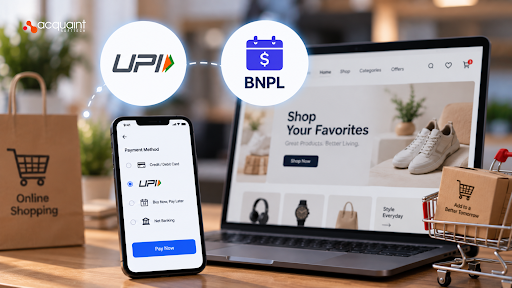
UPI is India’s real-time payment system that moves money instantly between bank accounts through apps like Google Pay, PhonePe, and Paytm. BNPL, or Buy Now Pay Later, is short-term credit that lets a shopper take the goods now and pay in installments. Offered together at checkout, they cover both the shopper who wants to pay instantly and the one who wants to spread the cost.
Why the pairing converts
UPI removes friction for the shopper who has funds, and BNPL removes hesitation for the one who does not, especially younger buyers without credit cards. The newest twist is credit on UPI, which fuses the two: a short-term credit line drawn through the familiar UPI flow. Building both into checkout is a high-value slice of modern e-commerce architecture.
How UPI works for e-commerce
UPI works for e-commerce by letting a shopper approve a payment directly from their bank account inside a UPI app, with the money settling in real time. At checkout, the store sends a payment request through a gateway; the shopper authorizes it in their UPI app with a PIN, and the store receives instant confirmation. No card details are stored, which reduces both friction and risk.
Behind that simplicity sits the NPCI network, the banks, and a payment gateway that the store integrates with. Getting the UPI integration right is where a store either feels instant or drops shoppers at the final step, and it is a job for engineers who have shipped payments before, which is why many teams hire Laravel developers with payment experience for the checkout backend.
UPI flows: Intent, collect, and QR
There are three UPI flows, and choosing the right one per surface is central to good payment flow design. UPI Intent deep-links straight into the shopper’s UPI app on mobile, collect sends a pull request to a UPI ID the shopper enters, and dynamic QR shows a scannable code for desktop or in-store. Each fits a different context.
| UPI flow | How it works | Best for |
| UPI Intent | Deep-links into the UPI app to approve | Mobile web and apps |
| UPI collect | Sends a pull request to a UPI ID | Desktop, entered UPI ID |
| Dynamic QR | Shopper scans a generated QR code | Desktop checkout, in-store |
On mobile, Intent converts best because it removes typing; on desktop, QR and collect cover the gap. A well-built checkout picks the flow automatically based on the shopper’s device, which is a small detail that meaningfully lifts completion.
04 How BNPL and credit on UPI work
BNPL works by inserting a fintech lender between the shopper and the merchant: the lender pays the store in full immediately and collects from the shopper later in installments.
The merchant carries no credit risk and is settled upfront, while the shopper gets flexibility. Credit on UPI applies the same idea through a pre-approved credit line drawn via the UPI flow.
- Instant settlement: the BNPL or fintech partner assumes the credit risk and pays the merchant right away.
- Installment repayment: the shopper repays the lender over weeks or months, often interest-free for a short window.
- Conversion lift: lowering purchase hesitation for Gen Z and millennial buyers without traditional credit cards.
Choosing a payment gateway
The fastest path to UPI and BNPL is a single gateway that bundles both, rather than signing separate deals with many lenders. Major Indian gateways such as PayU, Razorpay, and Cashfree natively support UPI, credit on UPI, and BNPL under one integration and one dashboard, which keeps reconciliation simple. Choose the one whose coverage and settlement terms fit your catalog.
Look for a gateway that bundles Pay Later, EMI, and credit on UPI behind one API, since a single UPI BNPL payment module is far easier to run than a stack of separate providers. Wiring that gateway cleanly into the store is the heart of the API integration e-commerce work, and it is commonly delivered through software development outsourcing when an in-house team is at capacity.
The integration flow, step by step
Knowing how to implement UPI and BNPL comes down to a repeatable sequence. The steps below are the same whether you build a custom checkout or add the module to Shopify, WooCommerce, or Magento, and following them in order keeps the build clean.
- Onboard and get keys. Complete merchant KYC with PAN, GST, and bank details, then collect sandbox and production API keys.
- Deploy by API or plugin. Install the platform plugin or wire the server-to-server REST APIs to create a payment session.
- Render checkout options. Show UPI Intent or QR and a Pay Later via UPI widget side by side on the payment page.
- Handle authorization webhooks. Consume real-time webhook events to confirm success, trigger fulfillment, and reconcile.
- Test failures, then go live. Simulate declines, timeouts, and money-deducted-order-not-placed cases before production.
Handled this way, the checkout engineering stays modular, and each payment method can be tuned or swapped without breaking the others.
UPI AutoPay mandates for repayments
UPI AutoPay is the e-mandate feature that makes BNPL installments and subscriptions collect automatically. The shopper approves a mandate once, and the lender or merchant can then pull agreed amounts on schedule without re-asking for a PIN each time. This is what makes installment repayment smooth rather than a monthly chore the shopper might forget.
For BNPL, AutoPay mandates structure the repayment plan cleanly, and for subscription stores, they handle recurring billing the same way. Implementing mandates correctly, including amount caps and expiry, is detailed work, and the Acquaint Softtech team treats mandate handling as a first-class part of the build rather than an afterthought.
Webhooks, settlement, and reconciliation
The API call is the easy part; webhooks and reconciliation are the hard eighty percent. A gateway notifies the store of payment events through webhooks, and the store must record each one, update the order, and match it against settlement reports so the books always agree with the bank. Skipping this is how stores end up with paid orders that never ship and shipped orders never paid for.
- Treat webhooks as the source of truth, not the browser redirect, which shoppers can close.
- Make webhook handling idempotent so a repeated event never double-processes an order.
- Reconcile against settlement files daily to catch mismatches early.
Checkout UX that lifts conversion
Checkout optimization is where good payment engineering turns into revenue. Showing the right payment options in the right order, defaulting to UPI Intent on mobile, and surfacing Pay Later prominently for higher-value carts all reduce the hesitation that causes abandonment. The goal is the fewest taps between intent and confirmation.
Dynamic widgets that show a shopper their split-payment amount before they commit remove uncertainty and lift add-to-cart follow-through. Getting this interface right is as much design as engineering, and technical direction across the checkout is available through a virtual CTO when the team wants a second senior view.
Compliance and security in India
Payments in India sit under RBI oversight, and a compliant checkout is not optional. Use a PCI-DSS-compliant gateway so card data never touches your servers, follow RBI rules on tokenization and mandates, and keep clear audit trails for every transaction. Compliance is cheaper to build in than to retrofit after an audit.
Security and compliance are ongoing, not one-time, so the checkout needs monitoring and updates as rules evolve. That ongoing care is delivered through support and maintenance, which keeps the payment stack current with RBI and gateway changes.
What a payment build costs
The payment module cost in India depends on how many methods you support, whether BNPL and AutoPay are included, and how much custom reconciliation you need. The figures below reflect typical ranges to design and build the checkout and payment module, separate from gateway fees. A custom payment integration India-based build sits well below Western agency pricing for equivalent seniority.
| Scope | What it includes | Typical range (USD) |
| UPI only | Intent, QR, collect, webhooks, basic reconciliation | $3,000 to $7,000 |
| UPI plus BNPL | Above plus BNPL widget and settlement handling | $7,000 to $15,000 |
| Full checkout | Above plus AutoPay mandates, EMI, custom UX | $15,000 to $35,000 |
| Marketplace | Split settlements, multi-seller payouts, compliance | $35,000 and up |
Where the real savings are
Gateway fees are usage-based; the build and reconciliation are the one-time costs. A build checkout system with an India-based team lands at up to 40% cost savings versus Western agencies, with blended rates of roughly $20 to $45 per hour.
When you hire developers for checkout work, judge them on how they handle webhooks and reconciliation, not on how fast they render a pay button. Extending an in-house team fast is exactly what IT staff augmentation is built for.
Read Also: How Real Estate Brands Can Build a Stronger Online Presence in Mumbai
How to hire for a checkout build
The right hire for a checkout build understands three things: the UPI and BNPL flows, idempotent webhook handling, and reconciliation against settlement files. A generic developer can call a payment API, but payments are unforgiving, and the difference shows up as mismatched books and unshipped paid orders when it is done poorly.
Look for engineers who have shipped a real Indian checkout, because failure handling is learned from production, not tutorials. A full domain-ready pod is delivered as a dedicated development team, and scoping the work correctly first is the job of a short discovery workshop.
Proof: what UPI and BNPL changed at checkout
Payment options are easiest to judge by the checkout funnel. Acquaint Softtech rebuilt the payment layer for an India-facing marketplace on Lampoo’s platform, adding UPI and a Pay Later option to a checkout that had leaned on cards.
This account is drawn from the client’s verified 5.0 out of 5 Clutch review, and the log below traces what changed at each step of the funnel.
| Checkout step | Before | After |
| Preferred method | Cards only, high drop-off | UPI Intent default on mobile |
| Higher-value carts | Abandoned at price | Pay Later via UPI offered |
| Payment confirmation | Relied on browser redirect | Webhook-driven, reliable |
| Repayment on BNPL | Not offered | UPI AutoPay mandates |
| Books vs bank | Manual, error-prone | Automated daily reconciliation |
Each change fixed a specific leak: UPI Intent cut the mobile drop-off, a Pay Later widget rescued higher-value carts, and webhook-driven confirmation ended the paid-but-unshipped problem. Order processing ran on a Laravel asynchronous queue, so heavy checkout work never blocked the shopper.
The lesson is that payment options lift revenue only when the plumbing behind them, webhooks and reconciliation, is engineered as carefully as the button.
Expert insight from Sanjay Prajapati, Backend Lead
Questions buyers ask
How does UPI work for e-commerce?
At checkout, the store sends a payment request through a gateway; the shopper approves it in their UPI app with a PIN, and the money moves from bank to bank in real time with instant confirmation. No card details are stored. On mobile, the UPI Intent flow deep-links into the app, while desktop uses a QR code or a collect request.
How do you implement UPI and BNPL?
Choose a gateway that bundles UPI, credit on UPI, and BNPL, complete merchant KYC for API keys, then deploy by plugin or REST API. Render UPI and Pay Later options at checkout, and consume webhooks to confirm authorization, trigger fulfillment, and reconcile. Add UPI AutoPay mandates for BNPL installments, and test failure cases before going live.
What are the best practices for implementation?
Treat the webhook, not the browser redirect, as the source of truth, and make webhook handling idempotent so events never double-process. Default to UPI Intent on mobile, show Pay Later on higher-value carts, use a PCI-DSS-compliant gateway, and reconcile against settlement files daily. Build compliance and failure handling in from the start, not after launch.
What is the development cost?
A UPI-only checkout typically runs about $3,000 to $7,000, UPI plus BNPL about $7,000 to $15,000, and a full checkout with AutoPay and custom UX $15,000 to $35,000, separate from gateway fees. An India-based team delivers the same work at up to 40% below Western agency rates, with blended rates near $20 to $45 per hour.
Which 7 countries have UPI?
India’s UPI has been extended to several countries for cross-border and QR payments, including Bhutan, Nepal, Sri Lanka, Singapore, the UAE, France, and Mauritius, with more being added over time. Acceptance varies by use case and partner bank, so exact coverage changes as NPCI International signs new agreements, but those are the commonly cited early markets.
Which UPI has a pay later option?
Credit on UPI enables Pay Later through UPI apps by linking a pre-approved credit line, and several banks and apps support it. Gateways like PayU bundle Pay Later options such as LazyPay with UPI, so a merchant can offer UPI-linked credit at checkout through a single integration rather than signing with each lender separately.
Which country is number one in UPI?
India is number one in real-time digital payments, driven largely by UPI, which processes the highest volume of real-time transactions in the world by a wide margin. Its open, interoperable design and near-zero cost to users have made it the default way hundreds of millions of Indians pay both online and in-store.
Which is better, NEFT or UPI?
For most e-commerce, UPI is better: it settles instantly, works 24/7, and needs only a UPI ID or QR, making it ideal for everyday and lower-value purchases. NEFT suits larger, scheduled bank transfers where instant settlement is less critical. For checkout, UPI’s speed and simplicity make it the stronger default choice.


 By
By